Based in Switzerland • Advancing clinical neuroscience
 Donate ↗
RECIPE 01 NEUROVASCULAR / PEER EDITION
A recipe
for seeing
the invisible.
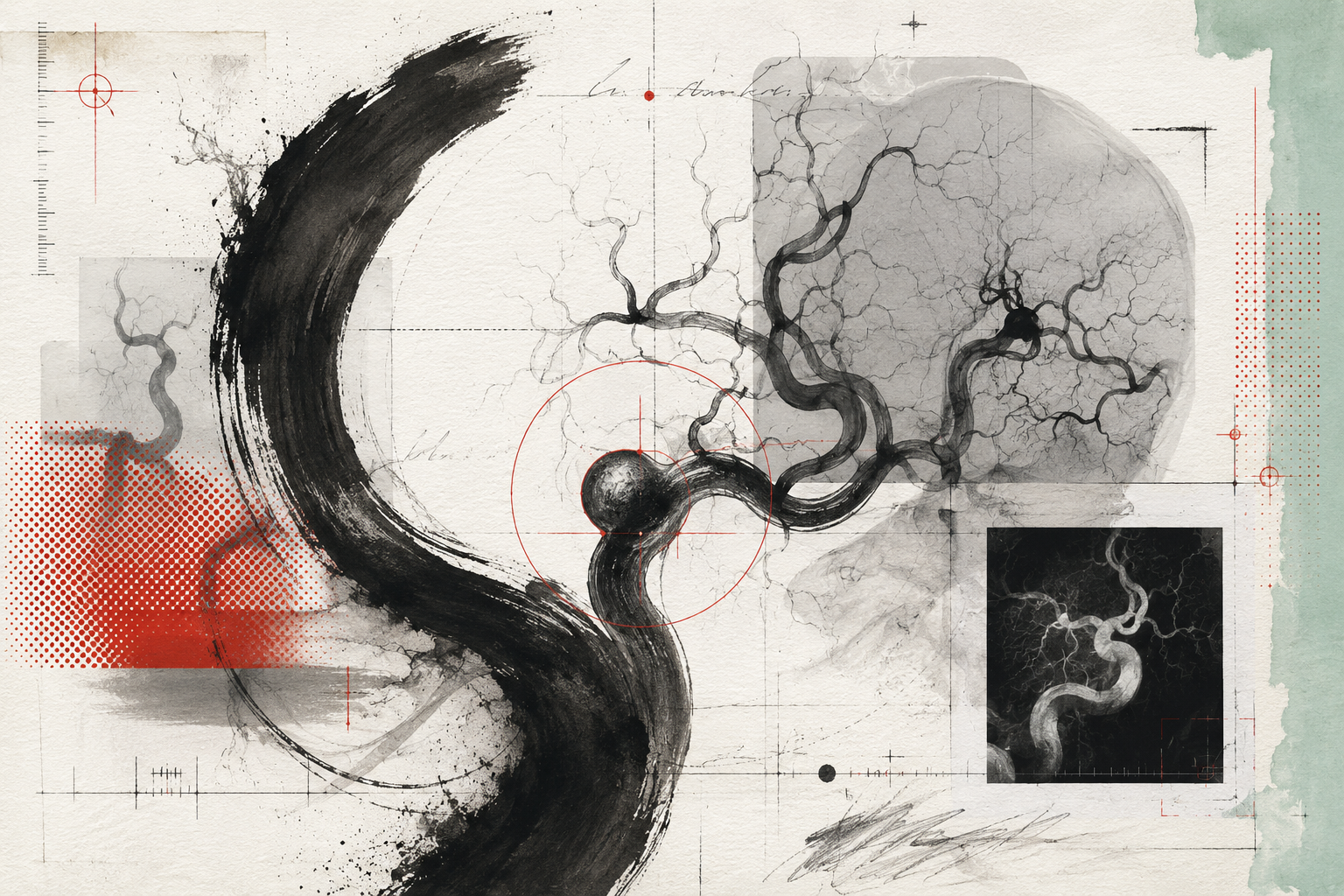
Incidental intracranial aneurysm—composed with time, wall information and clinical perspective.
01 / MISE EN PLACE
Lay out the
ingredients.
Not a shopping list. A field of observations whose meaning emerges through concordance, contradiction and change.
02 / THE COMPOSITION
Four movements.
No automatic answer.
Select a movement to unfold the expert reasoning.
01
OBSERVE
Read the lesion before naming the decision.
Interrogate lumen morphology, wall characteristics, thrombus, parent-vessel geometry and the perianeurysmal environment. Treat every image as a partial view of a dynamic biological system.
OUTPUT / LESION PHENOTYPE03 / CLINICAL BALANCE
Signals are cumulative.
Certainty is not.
This visual balance is a discussion aid, not a score.
RELATIVE REASSURANCENo documented growthRegular morphologyNo evident wall enhancementConcordant low-concern context
WHOLECOMPOSITION
CLOSER ATTENTIONInterval growthIrregular morphologyWall enhancement or thrombusConverging clinical modifiers
THE SECRET INGREDIENT
Time.
A single image is a moment. Longitudinal observation can reveal whether a lesion remains quiet or changes its character.
06 m12 m+
HOW TO SERVE
Without unnecessary certainty.
Present what is observed, what is inferred, what remains unresolved and what will happen next. The aim is not merely to select observation or intervention, but to make the reasoning transparent enough for a patient and a multidisciplinary team to understand together.
“We do not treat an image.
We interpret a living situation.”Editorial principle / Clinical Recipes