
Reconstructing the parent artery
Thinking through flow diversion as a biological sequence
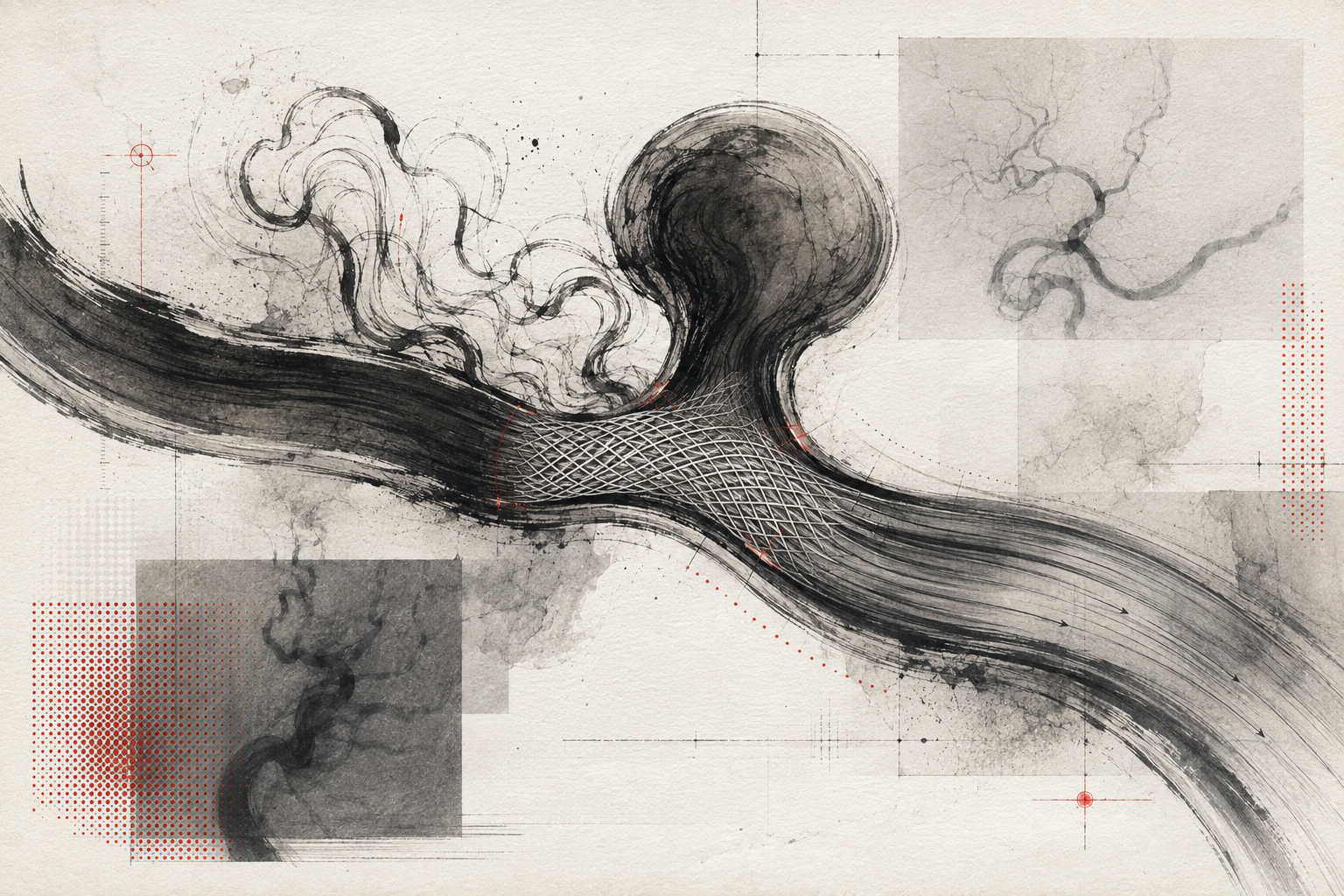
What must happen mechanically—and then biologically—for reconstruction to succeed?
Six ingredients,
one interpretation.
Four movements.
Plan
Understand geometry, branches and device behaviour before deployment.
Appose
Evaluate the device–wall relationship along the reconstructed segment.
Observe
Follow the evolving interaction between flow, thrombus and vessel wall.
Confirm
Judge reconstruction longitudinally rather than at one procedural moment.
Apposition.
The conceptual sequence begins with the relationship between device, wall and branches—then continues through altered flow, thrombus organisation and remodelling.
DEVICE / WALL / REMODELLINGHold both sides
in view.
Expert synthesis is rarely a choice between simple opposites. The work is to understand how each tension changes confidence.
Make the reasoning visible.
Describe mechanical configuration separately from the biological process expected to follow. Longitudinal imaging should show which part of that sequence has actually occurred.
“The implant is placed in a moment; reconstruction unfolds in biology.”Clinical Recipes / Editorial reflection
Three deeper
readings.
APPOSITION → FLOW → REMODELLING
Read the mechanical beginning
Landing zones, branch origins, curvature and device–wall contact define the initial condition. Describe configuration before attributing later appearances to biological response.
Follow the altered circulation
The intended change in inflow begins a sequence rather than completing it. Thrombus organisation, branch demand and device geometry interact over time; each follow-up captures only one moment in that process.
Judge reconstruction longitudinally
Occlusion and parent-artery remodelling should be read with branch patency, device configuration and clinical evolution. The final image cannot explain the path unless the intermediate states remain visible.
Questions for
colleagues.
- 01
Is the device–wall relationship adequately characterised?
- 02
Which expected biological step has actually occurred?
- 03
What does the current study not yet allow us to conclude?
The intervention is instantaneous; reconstruction is a negotiated process between metal, flow and vessel biology.
This is a conceptual educational sequence, not procedural guidance or a device-selection recommendation.