
Calibrating the image
Before calling biology, test the acquisition
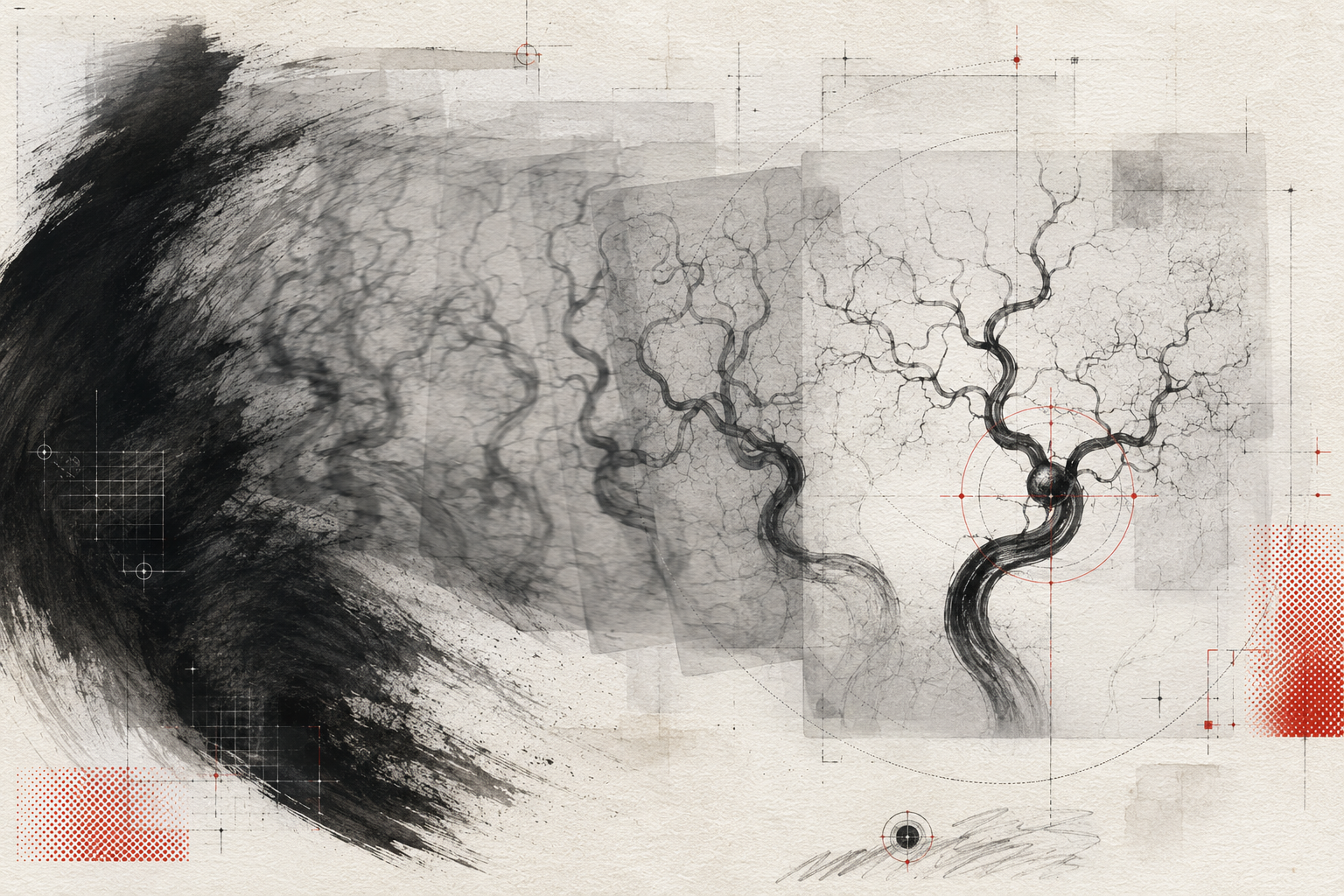
How much of the finding belongs to the lesion—and how much to the instrument?
Six ingredients,
one interpretation.
Four movements.
Inspect
Review source data before accepting a derived display.
Stress-test
Ask which technical factors could reproduce the apparent finding.
Compare
Seek confirmation across sequences, planes or modalities when appropriate.
Report
Express the confidence and limitation of the observation.
Source data.
Derived displays can be compelling. Returning to source images often reveals motion, flow-related effects, partial volume or processing choices that change confidence.
ACQUISITION / ARTEFACT / CONFIDENCEHold both sides
in view.
Expert synthesis is rarely a choice between simple opposites. The work is to understand how each tension changes confidence.
Make the reasoning visible.
State the observation, the technical vulnerabilities and the evidence that supports it across sequences, planes or modalities.
“Before interpreting biology, interrogate the instrument.”Clinical Recipes / Editorial reflection
Three deeper
readings.
ACQUISITION → ARTEFACT → CONFIDENCE
Return to the source
Derived maps and reformats can amplify visibility while concealing how the signal was produced. Inspect source images, orientation and acquisition parameters before accepting the most compelling display.
Reproduce the artefact mentally
Motion, partial volume, flow effects, susceptibility and post-processing can imitate biology. Ask which technical mechanism could generate the observation and where else its signature should appear.
Calibrate the language
Confirmation across sequences, planes or modalities raises confidence; technical vulnerability should soften it. Reporting should communicate both the finding and the stability of the evidence beneath it.
Questions for
colleagues.
- 01
Is the finding present in the source data?
- 02
Which artefact could plausibly reproduce it?
- 03
What corroboration would materially change confidence?
The image is evidence only after the instrument has been allowed to testify.
Technical quality and artefact assessment are prerequisites for responsible biological interpretation.