
From image to mechanism—and back
Designing a translational neurovascular research loop
Can this model survive the journey back to clinical complexity?
Six ingredients,
one interpretation.
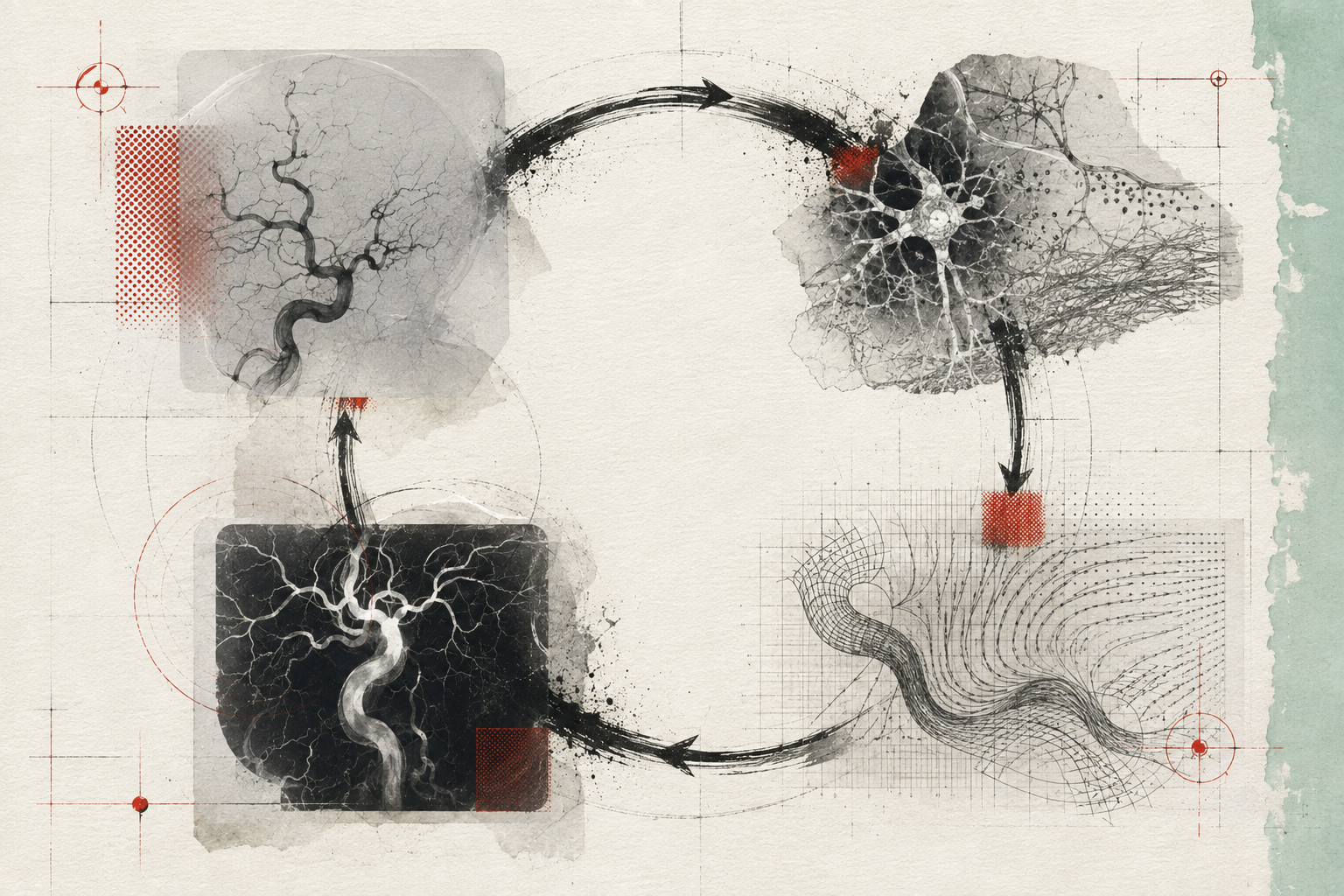
Four movements.
Observe
Start with a clinically consequential pattern or unresolved contradiction.
Model
Reduce the question without stripping away the biology that matters.
Validate
Test the proposed marker or mechanism beyond the environment that produced it.
Return
Bring the result back as a better question, tool or study—not an inflated claim.
Return journey.
A model becomes translational only when it travels back into clinical complexity, survives external validation and improves a meaningful question or decision.
OBSERVE / MODEL / VALIDATE / RETURNHold both sides
in view.
Expert synthesis is rarely a choice between simple opposites. The work is to understand how each tension changes confidence.
Make the reasoning visible.
Separate discovery, mechanistic plausibility and validation. Show where the evidence sits in the loop and what would be required before practice-facing use.
“Translation is complete only when the result can return to the bedside with humility.”Clinical Recipes / Editorial reflection
Translational evidence gains value through reproducibility, governance and clinically meaningful validation.